
Manual SEO submissions feel like control. Automation feels like a risk. But after running both approaches across hundreds of campaigns, the math is clear — and it’s not close. Here’s the honest comparison.
The Real Cost of Manual Submissions
Let’s put a number on manual directory submissions. An experienced SEO can submit to roughly 8–12 directories per hour when working carefully — filling forms, solving CAPTCHAs, handling email verifications, logging results.
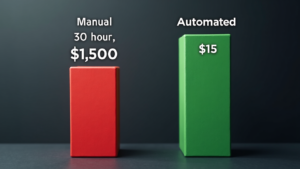
At 10 submissions per hour, 300 directories = 30 hours. At $50/hour for an SEO’s time, that’s $1,500 in labor for one campaign. For an agency running this monthly across 10 clients, that’s $180,000 per year — just for directory submissions.
With automation, the same 300 submissions run in 2–3 hours of oversight time after an initial 3–4 hour setup. Total: 6–7 hours for the first campaign, 2–3 hours for every subsequent run. Cost drops by 85%+.
Quality: Does Automation Hurt Submission Quality?
This is the legitimate concern about automation: will the submissions look spammy or be rejected at higher rates?
The honest answer: it depends on how you set up the automation. Poor automation — identical descriptions, no variation, no profile customization — does produce lower-quality submissions. Good automation — spintax descriptions, customized profiles per client, proper NAP formatting — produces submissions indistinguishable from manual ones.
The key differences:
- Description variation: Use spintax to generate natural variation across submissions
- Profile completeness: Fill in every field, including optional ones — incomplete profiles get rejected more often
- CAPTCHA handling: Use 2Captcha integration rather than trying to skip CAPTCHA fields
- Pacing: Add random delays between submissions to avoid triggering bot detection
With these practices, automated submissions perform comparably to manual ones in approval rates.
Accuracy: Is Manual More Accurate?
Counterintuitively, automation is often more accurate than manual submission. Humans make typos, copy-paste errors, and inconsistencies — especially after filling 50 identical forms in a row. Automation always uses the exact values from your profile.
This is particularly important for NAP consistency. A single character difference in your address format across 200 directories is a real local SEO problem. Automation eliminates this class of error entirely.
When Manual Submission Is Still Better
There are cases where manual submission genuinely wins:
- High-value editorial directories — sites like Product Hunt, Crunchbase, or niche media directories require personalized, high-quality descriptions and often involve editorial review. These deserve manual attention.
- Sites with complex custom forms — a handful of directories have forms so unusual that setting up automation takes longer than just filling them manually once.
- First submission to top-tier sites — for your 20 most important citations (Google, Yelp, Facebook, Apple Maps), do these manually to ensure perfect quality.
The hybrid approach — automate the bulk 80%, manual the top 20% — captures the efficiency gains while ensuring quality where it matters most.
The Verdict
For any SEO doing more than 50 directory submissions per month, automation pays for itself in the first campaign. The setup cost (learning the tool, creating profiles, recording replays for complex sites) is a one-time investment. Every subsequent campaign runs faster and costs less.
The question isn’t really “Fillnex vs manual.” It’s “do you want to spend 30 hours or 6 hours on your next link building campaign?” For most SEOs, that’s not a hard choice.
→ Learn more about SEO workflow automation extensions
See the difference for yourself
7-day free trial — run your first automated campaign at no cost.
Start Free Trial →