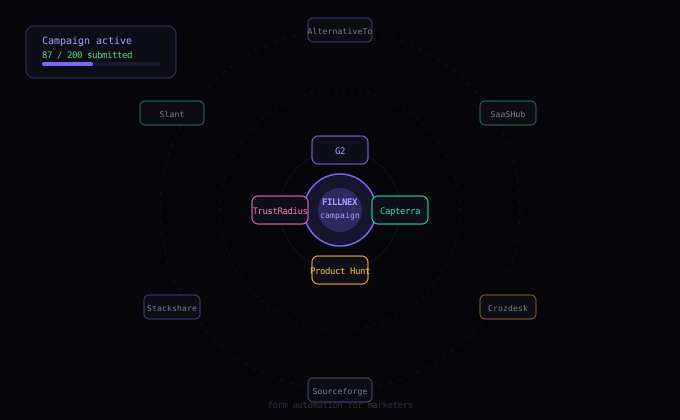
Marketing is a volume game. The more platforms you’re on, the more directories you’re listed in, the more outreach touchpoints you create — the more visible your brand becomes. The problem is that getting onto all those platforms requires filling forms. Hundreds of them. Here’s what form automation actually does for marketers and why it’s becoming a non-negotiable part of the modern marketing stack.
What Is Form Automation for Marketers?
Form automation for marketers is the use of browser-based tools to automatically fill out web forms — registration forms, submission forms, directory listings, outreach platform signups — using pre-saved profile data, without manual typing.
Unlike general productivity automation, marketing-specific form automation is optimized for high-volume workflows: submitting to dozens or hundreds of platforms in a single campaign, maintaining consistent brand messaging across all submissions, and handling the specific friction points marketers face — CAPTCHAs, multi-step registration flows, custom dropdown categories.
The Marketing Form Problem
Modern digital marketing requires a presence across a staggering number of platforms. A mid-sized SaaS company needs to be listed on G2, Capterra, GetApp, AlternativeTo, Product Hunt, SaaSHub, TrustRadius, and dozens of niche review sites. A local business needs citations on Google Business Profile, Yelp, Apple Maps, Bing Places, Yellow Pages, and hundreds of local directories. A content marketer needs accounts on HARO alternatives, journalist databases, content aggregators, and guest posting platforms.
Every single one of those listings starts with a form. And most of those forms ask for the same information — brand name, website, description, category, contact info — over and over again.
The cumulative time cost is enormous. Research on marketing team productivity consistently finds that administrative and data entry tasks consume 25–40% of available work time. Form submissions are a significant contributor to that overhead.
What Marketers Can Automate
Directory and review site listings: Software directories, industry directories, local business directories, review platforms. These are the highest-volume, most repetitive form tasks marketers face — and the most automatable.
Press release distribution: Free and paid PR sites all have submission forms. Automating across 50+ distribution sites multiplies press release reach with minimal additional effort.
Outreach platform registration: HARO alternatives, journalist request platforms, blogger outreach databases, podcast guest databases. Getting into all of them manually is a half-day job.
Partner and affiliate program applications: Every partner network, affiliate program, and co-marketing opportunity starts with an application form. Automation makes applying to dozens of programs feasible.
Event and webinar registration: Industry events, webinars, networking platforms — registering for competitive intelligence or partnership development at scale.
Social profile creation: Brand presence on all relevant social and professional platforms — LinkedIn, Twitter/X, Crunchbase, AngelList, etc.
How It Works in Practice
A browser-based form automation tool like Fillnex works by:
- Profile storage: You save your brand information once — name, website, description, contact info, category, tagline — with spintax variations for text fields that shouldn’t be identical across submissions
- Intelligent detection: The extension automatically identifies form fields on any website, mapping them to your saved profile data
- Campaign execution: You build a list of target URLs and run a campaign — the extension opens each site, fills the form, and moves to the next automatically
- Exception handling: CAPTCHAs are solved automatically via 2Captcha integration; complex multi-step flows are handled via Form Replay recordings
The ROI for Marketing Teams
The math on marketing form automation is straightforward. A marketing manager spending 8 hours per week on manual platform submissions at $60/hour is spending $24,960/year in labor on data entry. An automation tool that costs $180/year and reduces that to 2 hours per week saves $22,560 annually — a 125× ROI.
Beyond the direct time savings, the real value is in the volume ceiling removal. With manual processes, a marketing team can realistically maintain a presence on 50–100 platforms. With automation, the same team can maintain presence on 300–500 platforms — creating a compound visibility advantage that accumulates over months and years.
What Form Automation Doesn’t Replace
Form automation handles the mechanical submission work. It doesn’t replace strategic decisions about which platforms to prioritize, creative work on brand messaging and positioning, relationship-based outreach that requires personalization, or editorial submissions that require unique, high-quality content.
The best marketing automation strategy uses form automation for the bulk mechanical work (80%+ of submissions) while preserving manual effort for the high-value editorial and relationship work where human judgment genuinely matters.
Automate your marketing form submissions
Start your 7-day free trial and run your first campaign today.
Start Free Trial →