
Local SEO lives and dies on citation consistency. For agencies managing multiple local clients, building and maintaining citations manually is unsustainable. This is the complete playbook for automating local citation campaigns at agency scale.
Why Citation Automation Is Essential for Local SEO Agencies
Local ranking factors fall into three main categories: Google Business Profile signals, review signals, and citation signals. Citations are the easiest to control programmatically — they’re just consistent NAP data across structured directories. But the volume required makes manual processes impractical.
A typical local SEO campaign requires 200–500 citations for competitive markets. At 10 submissions per hour manually, that’s 20–50 hours per client. For an agency with 10 local clients, citation building alone would require one dedicated full-time employee just to keep up.
Automation reduces this to 2–4 hours of setup per client, then 1–2 hours per month for maintenance and new submissions.
The NAP Standardization Process
Before any automation, standardize your client’s NAP. This is non-negotiable:
- Audit existing citations — use Moz Local or BrightLocal to find all existing mentions and identify inconsistencies
- Choose canonical format — decide on the exact spelling, punctuation, and formatting for name, address, and phone
- Document it — create a NAP card for each client that every team member uses
- Enter it in the profile — this is the single source of truth that automation uses for every submission
Common NAP inconsistencies to watch for: “Suite” vs “Ste.”, “Avenue” vs “Ave”, “(555) 123-4567” vs “555-123-4567”, business name abbreviations vs full names.
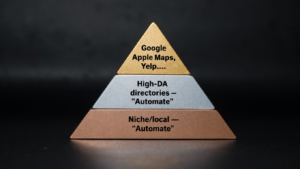
Tiered Citation Strategy
Not all citations are created equal. Structure your campaigns in tiers:
Tier 1 — Top aggregators (do these manually): Google Business Profile, Apple Maps, Bing Places, Facebook, Yelp, TripAdvisor (if relevant). These get the most traffic and scrutiny. Do them manually with complete, high-quality listing info.
Tier 2 — High-DA general directories (automate): Yellow Pages, Manta, Hotfrog, Foursquare, Better Business Bureau, Chamber of Commerce sites. High authority, worth the effort, but standardized enough for automation.
Tier 3 — Niche and local directories (automate): Industry-specific directories, local city guides, neighborhood business directories. Lower individual impact but high cumulative value.
Building Client-Specific Campaign Lists
Your master list covers Tier 2 and Tier 3 universal directories. For each client, supplement with:
- City-specific directories: “[city] business directory”, “[city] chamber of commerce”
- Neighborhood directories if targeting a specific area
- Industry directories: “[industry] directory”, “[niche] business listing”
- Local news sites that accept business listings
Research using Whitespark Citation Finder filtered by city and category — it shows where competitors are listed and estimates citation impact.
Handling NAP Variations for Multi-Location Clients
For clients with multiple locations, create one profile per location in your automation extension. Each profile has the exact NAP for that location, and you run separate campaigns for each.
Don’t mix location data across campaigns — this creates citation pollution that hurts local rankings. Each location should have its own clean citation footprint.
Monthly Maintenance Workflow
Citation building isn’t a one-time project. New directories launch, old ones update their forms, and clients add new locations. Build a monthly maintenance process:
- Check for citation errors in BrightLocal (NAP mismatches, duplicate listings)
- Add 20–50 new directories to the existing campaign
- Run corrections on any sites with wrong NAP data
- Document new live listings in the client’s master spreadsheet
With automation, this monthly maintenance takes 1–2 hours per client instead of 5–10.
Reporting Citation Impact to Clients
Track and report:
- Total citations built (cumulative)
- New citations this month
- Local pack ranking position for target keywords (weekly)
- Google Business Profile impressions and actions (monthly)
- Estimated citation coverage vs top local competitors
Clients understand citation volume intuitively — “we’ve submitted your business to 350 directories this quarter” is a concrete deliverable that demonstrates value clearly.
→ What is a SEO workflow automation extension?
→ Agency workflow: 10 clients, 200 directories, one day
Scale your local SEO citation campaigns
Agency plan includes multiple profiles for all your clients.
Try Agency Plan →